Table of contents
Hypothesis testing is one of the most common topics in statistics homework. It shows up in research methods, psychology, business, biology, economics, and many other courses. The problem is that many students memorize steps without understanding what the result actually means. This guide explains hypothesis testing in a clear, practical way, so you can confidently solve assignments and interpret p-values correctly.
What Is Hypothesis Testing?
Hypothesis testing is a structured method used to decide whether the evidence in a sample supports a claim about a population.
You start with two statements:
-
the null hypothesis (H0): the “default” position, usually “no effect” or “no difference”
-
the alternative hypothesis (H1 or Ha): what you want to test for, such as an effect, difference, or relationship
You collect data, run a statistical test, and decide whether the data provides enough evidence to reject the null hypothesis.
Why Students Get Confused
Most confusion comes from mixing up three ideas:
-
what H0 and Ha represent
-
what a p-value actually means
-
what “reject” vs “fail to reject” implies
A hypothesis test does not prove a statement with 100% certainty. It tells you whether your data is strong enough to support a conclusion under a chosen error tolerance.
The Key Terms You Must Understand
Significance Level (α)
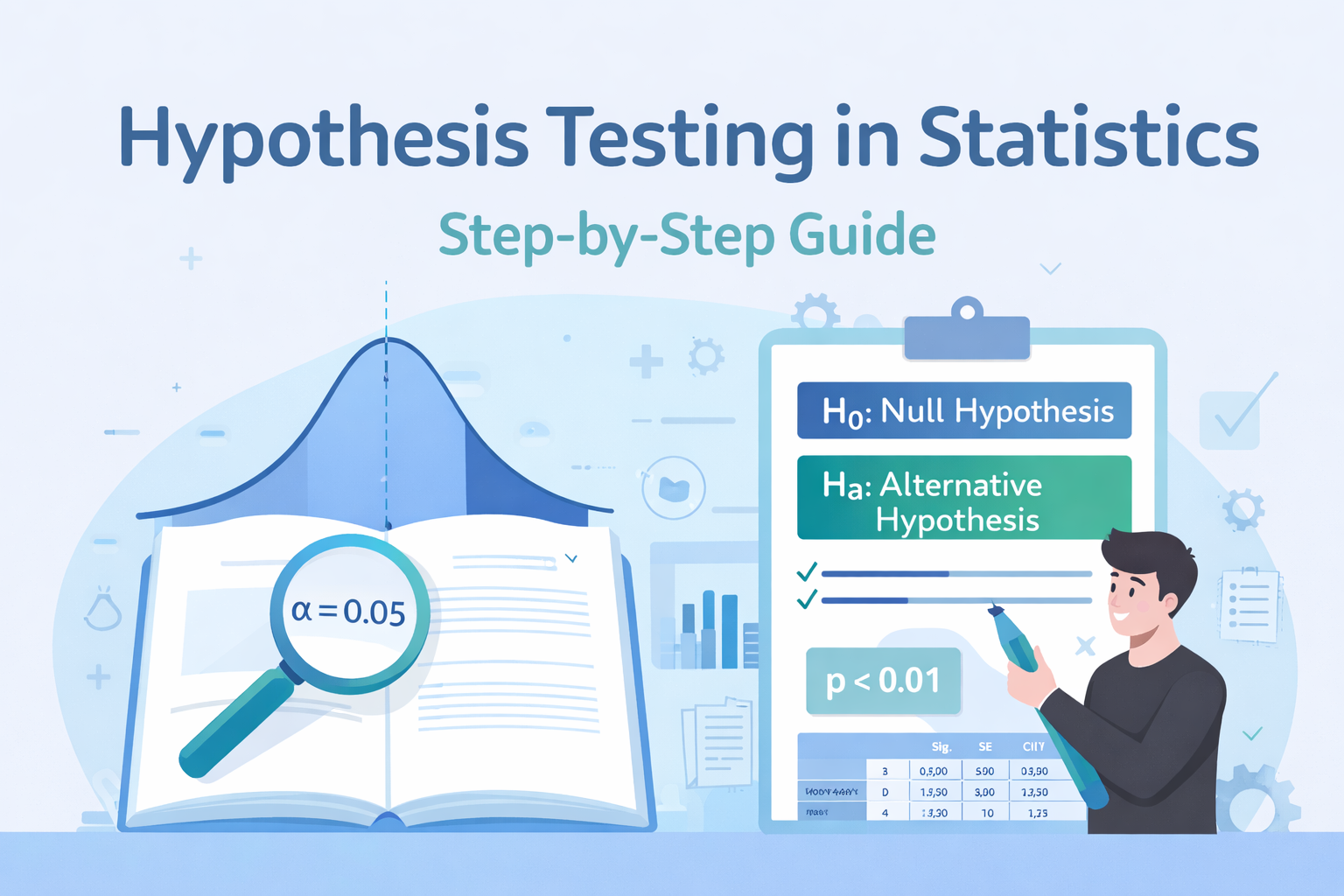
The significance level (alpha) is a threshold you choose before you run the test. Common values are 0.05 and 0.01.
Alpha represents the risk you accept for a Type I error (rejecting H0 when H0 is actually true). In plain terms: alpha is how strict you want to be.
P-value
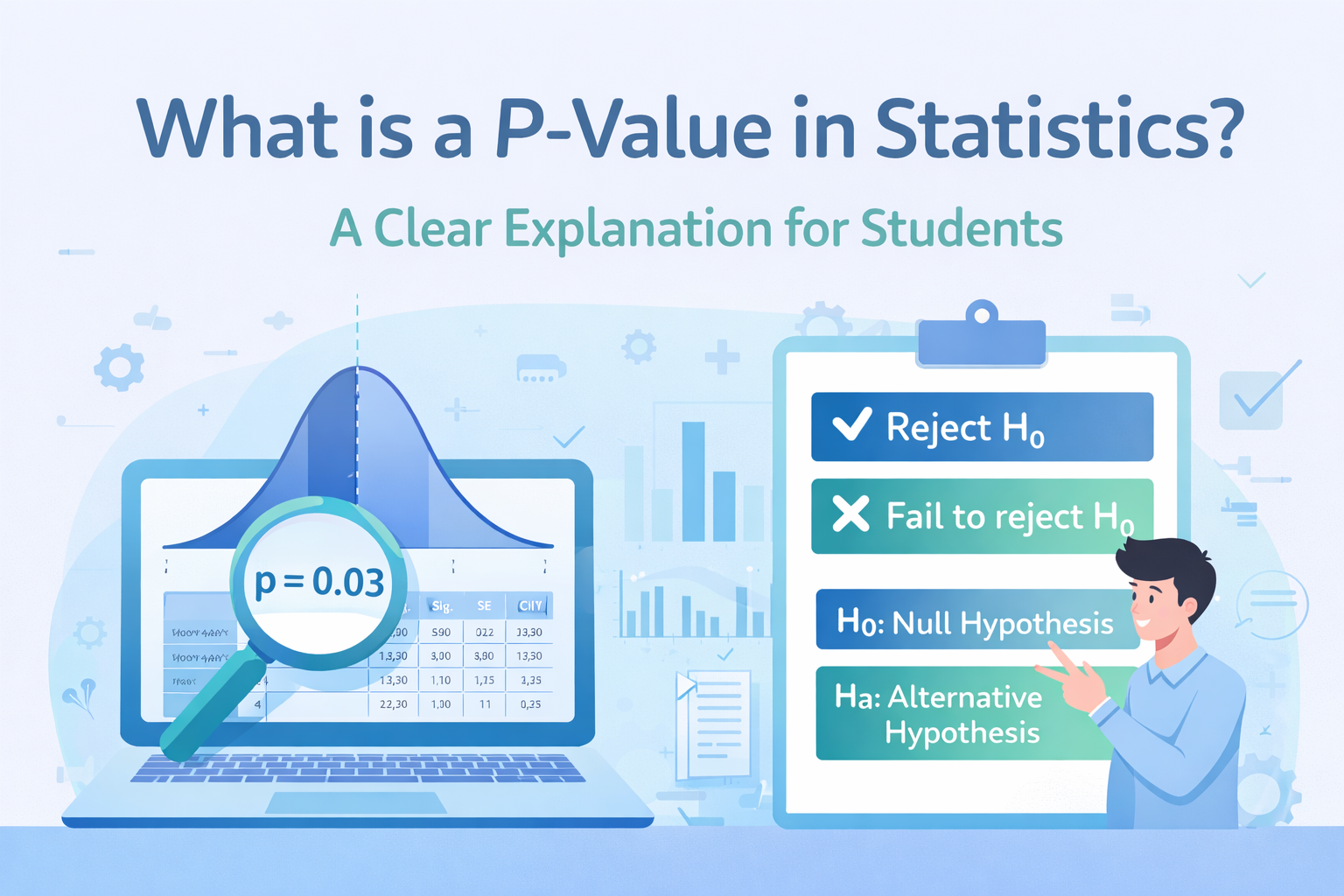
A p-value tells you how unusual your data would be if the null hypothesis were true.
If the p-value is small, the data would be unlikely under H0, so you consider rejecting H0.
Important: a p-value is not the probability that H0 is true. That’s one of the most common mistakes in homework.
Test Statistic
A test statistic is a number calculated from your sample. It measures how far your result is from what the null hypothesis expects, using a standardized scale (z, t, χ², F, etc.).
The Hypothesis Testing Process (Step-by-Step)
Here is the clean process most instructors want to see:
-
State H0 and Ha clearly
-
Choose α (like 0.05)
-
Select the correct test (t-test, chi-square, ANOVA, regression, etc.)
-
Check key assumptions (this matters a lot in grading)
-
Compute the test statistic and p-value
-
Make a decision (reject or fail to reject H0)
-
Write a conclusion in plain language that answers the question
If you follow this structure, you’ll usually match the rubric.
One-Tailed vs Two-Tailed Tests
A two-tailed test checks for a difference in either direction (higher or lower). It’s used when the question is “is it different?”
A one-tailed test checks for a difference in one specific direction (only higher or only lower). It’s used when the question is directional, such as “is it greater than?”
A common homework mistake is picking a one-tailed test just because it seems “easier.” Your tail choice must match how Ha is written and what the research question states.
How to Choose the Correct Statistical Test
Your choice depends on the type of variables and the question:
Comparing averages
-
one sample mean vs value: one-sample t-test
-
two independent groups: independent t-test
-
same group before/after: paired t-test
-
more than two groups: ANOVA
Relationships between variables
-
association between categorical variables: chi-square test
-
relationship between numeric variables: correlation or regression
If your homework includes software output (SPSS, R, Excel), your instructor usually wants you to identify the test used and interpret key values, not just copy numbers.
How to Write a Strong Conclusion
Your conclusion should have three parts:
-
the decision (reject/fail to reject H0)
-
the evidence (p-value compared to α)
-
the meaning in context (what it implies about the real-world question)
Example structure:
“At α = 0.05, the p-value was below 0.05, so we reject H0. This suggests there is a statistically significant difference in …”
Avoid dramatic language like “proves” or “guarantees.” In statistics, you support evidence; you don’t prove absolute truth.
Common Mistakes That Lose Points
Misinterpreting the p-value
Students often write: “p-value is the probability that the null hypothesis is true.” That is incorrect.
Forgetting assumptions
Many tests require assumptions (normality, independence, equal variances). Instructors often grade this.
Using the wrong test
If you choose a t-test when you should use chi-square, everything after that becomes incorrect.
Reporting results without context
A good answer explains what the result means for the question asked, not just the math.
Final Takeaway
Hypothesis testing becomes manageable when you focus on the logic: define H0 and Ha, pick the right test, interpret the p-value properly, and write a conclusion that directly answers the assignment prompt. If you can explain the result in plain language, you understand it well enough to submit strong homework solutions.
It is easy to check materials for uniqueness using our high-quality anti-plagiarism service.
Order now »