Table of contents
The p-value is one of the most misunderstood concepts in statistics. Many students can calculate it using software but struggle to explain what it actually represents. This often leads to weak conclusions, incorrect interpretations, and lost points in homework and exams. This article explains what a p-value is, how it is used, and how to interpret it correctly in academic assignments.
What Does a P-Value Mean?
A p-value measures how compatible your sample data is with the null hypothesis.
More precisely, it shows the probability of obtaining results at least as extreme as the observed ones, assuming the null hypothesis is true.
A small p-value indicates that the observed data would be unlikely if the null hypothesis were correct. A larger p-value suggests that the data is consistent with the null hypothesis.
What a P-Value Is Not
Many mistakes come from misunderstanding what a p-value does not represent.
A p-value is not:
-
the probability that the null hypothesis is true
-
the probability that your result happened “by chance” alone
-
a measure of the size or importance of an effect
It is a measure of evidence against the null hypothesis, not a direct statement of truth.
How P-Values Are Used in Hypothesis Testing
In hypothesis testing, the p-value is compared to a predefined significance level, usually denoted as alpha (α).
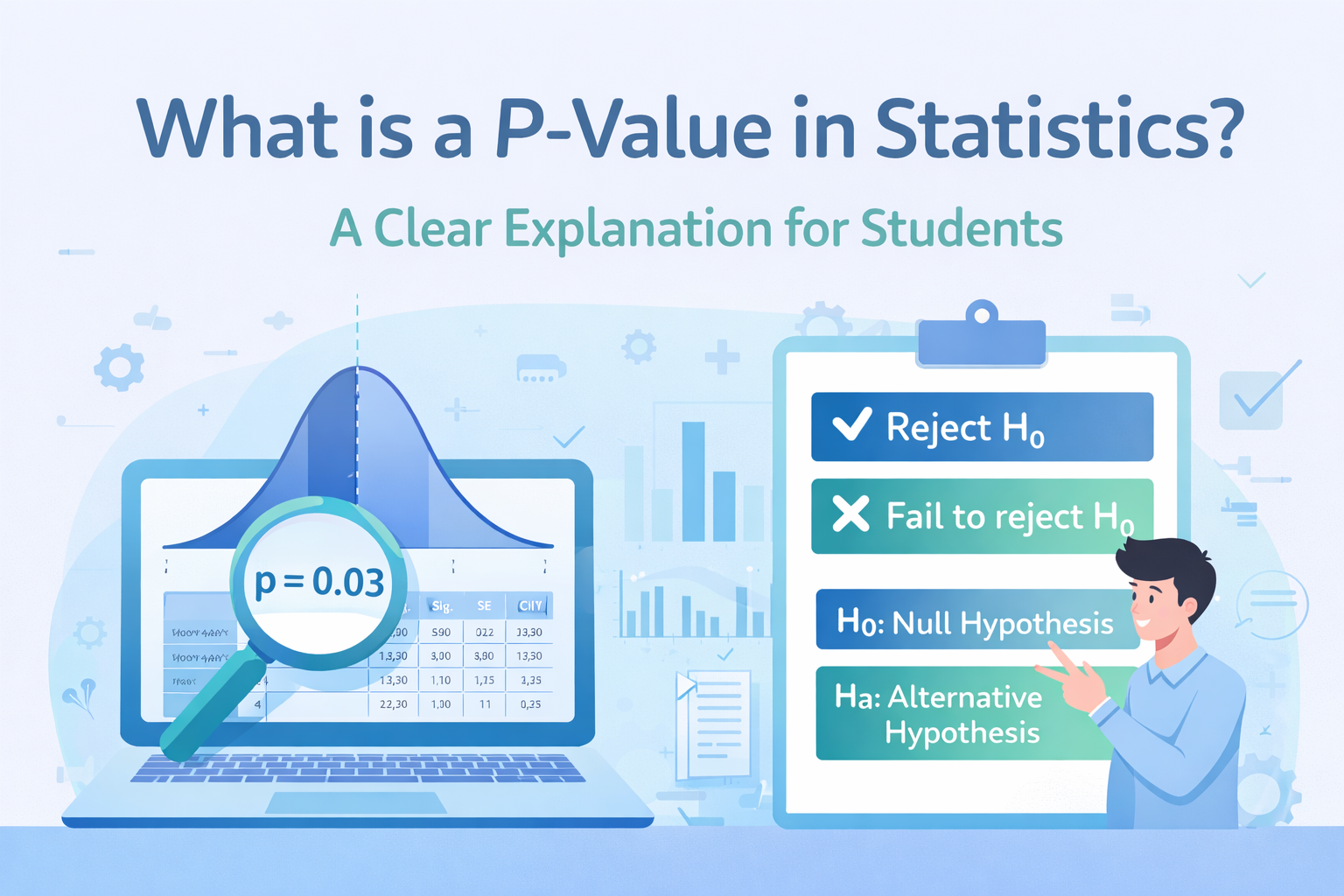
If the p-value is less than or equal to α, you reject the null hypothesis.
If the p-value is greater than α, you fail to reject the null hypothesis.
This comparison provides a consistent decision rule across different tests and disciplines.
Common Significance Levels
Most instructors expect one of the following alpha values unless stated otherwise:
-
0.05 for standard academic work
-
0.01 for stricter testing
-
0.10 in exploratory or preliminary studies
Choosing alpha before running the test is important. Changing it afterward to fit the result is considered poor statistical practice.
Interpreting Small vs Large P-Values
A small p-value suggests strong evidence against the null hypothesis. This does not mean the alternative hypothesis is absolutely true, only that the data does not align well with H0.
A large p-value means the data does not provide enough evidence to reject H0. It does not prove that H0 is true; it simply indicates insufficient evidence.
This distinction is critical in academic writing.
Example of Correct Interpretation
Incorrect interpretation:
“The p-value is 0.03, so the null hypothesis is false.”
Correct interpretation:
“At a significance level of 0.05, the p-value of 0.03 indicates sufficient evidence to reject the null hypothesis.”
Clear language shows understanding and aligns with academic standards.
P-Values in Different Statistical Tests
P-values appear in many common tests, including:
-
t-tests
-
ANOVA
-
chi-square tests
-
correlation analysis
-
regression models
Although the calculations differ, the interpretation logic remains the same across tests. This consistency helps students apply the concept confidently in different courses.
Why Software Output Can Be Misleading
Statistical software often reports p-values without explanation. Students may focus on the number without understanding its context.
Instructors usually expect:
-
identification of the test used
-
reporting the p-value
-
comparison with alpha
-
interpretation in plain language related to the research question
Simply copying output values rarely earns full credit.
When a P-Value Alone Is Not Enough
A statistically significant p-value does not automatically imply practical or real-world importance.
Large sample sizes can produce small p-values even for trivial effects. This is why many instructors also emphasize effect sizes and confidence intervals.
Understanding this nuance improves the quality of analysis and written conclusions.
Final Thoughts
The p-value is a tool for decision-making, not a final answer on its own. When interpreted correctly, it helps students justify conclusions logically and clearly. Mastering p-value interpretation is a key step toward stronger performance in statistics homework and research-based assignments.
It is easy to check materials for uniqueness using our high-quality anti-plagiarism service.
Order now »